

Synthesis
Putting, Hegel, and a turtle.

Often enough, when I’m asked what I studied in school and I say philosophy, I’ll get asked the follow up question, “who’s your favorite philosopher?”
This is usually an odd question. Most people wouldn’t ask a chemistry student who their favorite chemist is. I guess that people assume that it’s like asking an English student their favorite author, or a music student their favorite composer, or an architecture student their favorite architect. There’s the assumption that the humanities deal with matters of taste, and that matters of taste say something about a person. Of course, philosophy, as a discipline, detests matters of taste, and the branch that deals with such matters (aesthetics) spends most of its time trying to be objective enough about taste-stuff to explain it away.
That’s not the problem, though, because asking a chemistry student who their favorite chemist is wouldn’t be that weird. It’d be esoteric and difficult, and the answer probably wouldn’t be all that illuminating, but it’s fair enough. No, the reason that “Who’s your favorite philosopher?” is a weird question is because, every time, it’s asked with a look to imply, “Out of everyone in human history, who’s work sums up how you think we all should live our lives, all the time?”
It’s way too big a question. I’ve been asked probably fifty times, and I still don’t have a prepared answer, because I don’t know how to prepare one. If you’re asking whose work most significantly changed my whole worldview, I’d say Sarah-Jane Leslie, my thesis advisor in college, whose work on generic generalizations and psychological essentialism is, without exaggeration, what allows me to fight my overthinking demons and be a better version of myself every day. This would be an insane answer. It’s a bit like saying that Rhein Gibson is your favorite professional golfer — it’s an esoteric enough choice that you’d never make unless you knew them personally. I guess another answer could be Alva Noë, a philosopher at UC Berkley whose book The Entanglement I picked up a couple years ago and really, really enjoyed (and recommend). I guess that’d be like saying your favorite golfer is Paul Waring.
Both of these fail for being too niche — they’re people whose worldviews and perspectives I really enjoyed, mostly because they gave me a perspective on the world that I needed at the time I found them. That’s what I think it’s all about, anyways — “how we should all live our lives, all the time” and such. It pretty obviously depends on what you’re looking for.
If you want me to take your question more seriously, then I’d pick someone who leans into this ethos itself, in a meta sort of way — that everything is changing all the time, that seeing and interpreting the world dogmatically leads to imprecision and suffering, and that the best we can do is to pay attention with an open mind. So my answer would be the Buddha. But nobody wants to hear that, either.
So, while I search for an acceptable answer, I say Hegel. And that’s become my answer.
I never studied Hegel formally, but I have a funny story about him. The department threw a party for us when we turned in our theses, and my professor joked that “remember, your oral exams are on all of philosophy, so make sure you study up.” I had downed five Budweisers with some classmates in the basement bathroom (this was before we walked in, saw the professors were serving Martinelli’s, and realized this wasn’t a boozy event), and so I was loosened up enough to play along: “Oh my God, even Hegel?” The professor turned to a colleague, they looked at each other, and they laughed before saying, “God, which one was he again?” In a discipline that prides itself on its breadth, nobody can know it all.
But Hegel is great. Primarily because you can fake it pretty easily with Hegel. He’s the best philosopher in history for completely butchering what he said and still coming away with something interesting.
The primary idea is the “dialectic,” which works like this. You start with an idea, called the thesis. You have a good deal of evidence to believe that your thesis is at least mostly true. However, you have another idea, called antithesis, which also seems true but totally contradicts your thesis. This seems like a problem: you think each thing is true on its own, but they can’t both be true, because each one falsifies the other. But, with some ingenuity and creativity, you can come up with a new idea, called the synthesis, that satisfies the truth of both your thesis and antithesis. At which point, your synthesis becomes a new thesis, which is then susceptible to a new antithesis, and the whole thing follows like so:
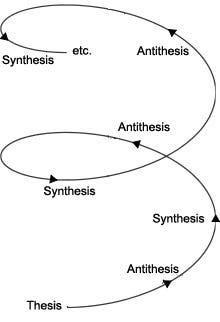
The funny thing is that even this brief summary of Hegel wouldn’t satisfy Hegel himself, because he never liked the terms “dialectic,” “thesis,” “antithesis,” and “synthesis” — because “Dialektik sometimes stands for the entire movement of the self-articulation of meaning or thought, this term refers more specifically to the self-negation of the determinations of the understanding (Verstand), when they are thought through in their fixedness and opposition.” To which I say: nah, screw you Hegel, we’re using our words.
At this point, you’ve seen a diagram and read a sentence that makes zero sense, and you’re probably assuming this is one of those newsletters that’s not about golf. Not so fast! All of this is about putting.
When I was in high school, I went six or seven weeks1 once without missing a putt inside 10’. This sounds nuts, but I swear it, at least in spirit. I couldn’t have possibly seen the line more clearly, and it felt like the ball was in a groove going to the middle of the hole. Golf couldn’t have been more fun.
That was eight years ago. Since then, I’ve produced a lot of good putting. But I’ve also produced a lot of shit putting. And I probably haven’t focused on my putting as much as I should — in my head, I’m a good putter, and I practice putting a lot, and both of those should end up being good enough. But, statistically speaking, I’ve put like total shit pretty much since I’ve turned professional.
At some point last year, 19 of the top 20 putters in the world used mallet putters. The lone exception was Ben Griffin, who used a blade. In November, Ben decided that he was tired of guys putting better than him, and everyone better than him was using a mallet. So he switched to a mallet. The first week he used it, he won at the World Wide Technologies. And then all 20 of the top 20 putters in the world were using mallets. As best I can tell, as of writing, 49 of the top 50 players in SG:Putting are using mallet putters (the lone exception: Jordan Spieth). 2
So I switched to a mallet. I had been putting like shit, and I figured switching couldn’t hurt. I continued to putt like shit. I went back to the blade, and putt like shit. And then, a month ago, I went and got another mallet. This mallet is face balanced, meaning that the center of gravity is on the same axis as the shaft with respect to the target line, promoting some stuff to do with face rotation during the stroke — allegedly, at least. Anyways, I’ve still been putting like shit.
Intermission:
In the middle of writing this, I had a bunch of milk crates deliver from Amazon, and I took a break to organize my trunk. I moved my stuff from cardboard boxes into the milk crates, then took the cardboard boxes to the dumpster, and…

…why is there a snapping turtle in my driveway?

The nearest pond I can find on a map is a couple hundred yards from my complex. What the hell is going on?
Anyways, back to our regularly scheduled programming.
I had gone back to my blade at some point: I’d complained about feeling like I never felt lined up right with my old mallet, and a coach confirmed that I had trouble aligning myself. I went back to my blade, and I could line myself up great. But, over my next two events, my speed control started to suck. And I figured: mallets are more forgiving than blades, and, if I have a more forgiving putter, the ball will come off more consistently, and my speed control will be better. I was also told that I should try something face-balanced (see above), and so I got myself a new mallet to see how that would work.
When I picked up that new mallet, I told myself that I was free to experiment with it however I wanted. I ended up buying a couple different grips and as many weights as I could find, both head weights and counterbalance weights. And I did a test (with the help of my friend David): we marked a line on the ground at 20’ on a flat putt, and I rolled two balls at the line with a bunch of different weight combinations. For each combo, we saw how close the balls ended up to the line — and you only hit two putts, so you couldn’t get use to anything and it stayed purely reactive. Generally, I hit it past the line with heavier weights and left it short of the line with lighter weights. We found a combination where it felt super natural to stop balls right on the line, and then we measured the putter.
Two numbers are important here. First is total weight, which you measure in grams. But that’s only part of it. Imagine two clubs, both the same weight, but one had a really heavy head, and the other had a super light head but a bunch of weight in the grip. The heavy head club would feel heavier when you swung it, even though they’re the same weight. So you need to measure the “swing weight,” which measures where the weight in a golf club is distributed — effectively, how heavy the club will feel when you swing it. And you measure it on a device that looks like this (though usually something way more professional-looking):
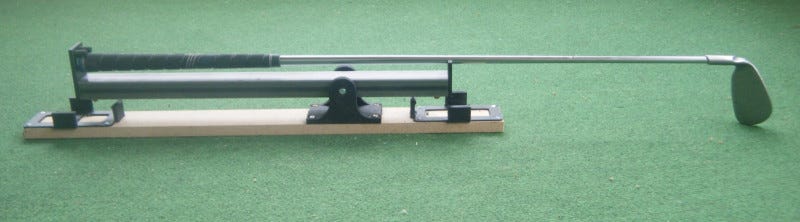
Swing weights are measured on a “swing weight point” scale, measured from A-G and subdivided with numbers. My driver, for example, plays at D2, while my irons play at D4 — which means that my irons feel heavier than my driver. Both of these are pretty standard. Most swingweights are probably in the low-mid Ds, but I’ve seen a couple people play stuff at E0-E2 (usually wedges). Though that’s not always the case for putters.
Here’s my specs that I settled on with putter, the one I did the weight testing on:
Scotty Cameron Phantom X5 33.5” (face balanced)
Total Weight: 561.4g
Swing Weight: D8.4
I measured up my blade, the one I’d putt with for 12 years before toying around with mallets. Here’s what I got
Scotty Cameron Newport 2 33” (2014 — my OG)
Total Weight: 548.2g
Swing Weight: C9.7
I don’t have a great feel for how significant those 13g of total weight are, but I can tell you that 9 swing weight points is enormous.
I played real shitty this week, to an extent that I don’t really want to talk about. This is especially true because, in the last three days, I’ve been working hard on some new, really simple stuff, and I’m feeling really, really confident in how it’s going. So I’m deciding to focus on the positives more than the negatives and spare you the details.
But I had an eight hour drive home, a long time to think about all the putts I stood over that I never felt had a prayer of going it. I might as well have been putting blindfolded. And I decided, with the wisdom that comes only when you’re really, really fed up, that I wasn’t going to hit a putt with a mallet for a long time. Fuck it. I’d never putt well for any extended period of time with a mallet. I’d putt well in the past with a blade. We’re going back.
I didn’t have the heart to gut my longtime gamer, adding length and changing out weights. So I went to Edwin Watts and got another Newport 2 blade, this one an inch longer at 34”. I also found an identical grip to what came on the putter — Edwin Watts has a 90-day return policy, and, worst case, I’d throw the original grip back on it and nobody would be the wiser (my sister claims this is in the time honored tradition of “wearing the dress with the tags on”). I threw a Ping grip on it that felt nice, checked the weights (a little light, but decent — something I could hone in with some tape), and went out to putt.
I’ve spent a lot of time practicing my putting in the last few months. I have my own version of aimpoint to check my reads. I have an alignment stick to measure out my feet at address and keep it consistent, and it’s marked with ideal stroke lengths for a bunch of different putts. I found these ideal stroke lengths by building a model in Claude Code with some ideal physics. I’ve learned a shitload about putting in the last few months.
I went out to put with the new putter, a familiar shape I’d looked down at for 12 straight years, with some better weighting — and, suddenly, it all clicked. It all collapsed into one singularity. I was hitting putts that I knew, straight off the face, were going in the hole. I’d under-read one, and I’d know off the face that it would miss a hair low. I felt like I’d completely unlocked my ability to use all the skills that I developed.
I hit 100 4-footers in a row, a drill I do to practice my start line. I made all 100. Then I did a drill where I hit five 4-footers, three 6-footers, and two 8-footers from all sides of the hole. The goal is to make nine of the ten. I misread one, made the other nine, went back to the one I missed and drilled it in the center.
Without giving too much detail, I feel very similarly about the rest of my game right now: I’ve gotten some advice on how to practice and what to work on that really feels like it’s opened things up for me. And I’m excited about the future. We’ll see how it all goes — nothing counts until you’re able to pull it off in competition, after all. But I’m walking around with my head higher than I would’ve thought at the beginning of the week.
I said Hegel is my favorite philosopher (ish) because he’s the easiest to misinterpret effectively. As I’ve told the story, here, I’m realizing: there’s not much thesis-antithesis-synthesis going on with my putting. More accurately, I had two putters, I putt badly with them for two different reasons, and, once I isolated the variables and built a putter that works for me, I no longer feel like I’m putting terribly.
You see where I was trying to go, right? That each idea I had was contradicted by poor play until I was able to come up with a more universal solution?
Luckily for me, even Hegel wasn’t big on technicalities, it seems. He was dogmatically anti-dogmatic. Maybe. Even some of my professors didn’t know. But, at least, I hope he’d be glad I found an answer.
SIX SEVEEEEEEN!!
Caveat: I had Claude help me sort this out, and I don’t really trust its answers, but the sentiment is still pretty damn strong.
I really enjoy your writing style and how you discussed a complex philosopher like Hegel with examples from your daily life, a beautiful closing, and great emphasis on Hegel's interpretability ahhaha
I wonder whether your stroke length calculations came out similar to the Phil Kenyon Tempostik, which performs a similar function (takes distance, slope, stimp, and through tempo and spits out a backstroke length)