

Waterloo
My trip to Belgium, the thinness of margins, and the other holy trinity.

You might be aware that European exterior doors operate differently than US doors. In the US, there’s a knob and a deadbolt. If you turn the knob, the door opens. If you want to lock the door, you turn the deadbolt. Some doorknobs have a little thumb-turn mechanism that locks up the knob so you can’t turn it, but I don’t really know many people who use these, and they have to be engaged from the inside anyways.
This isn’t the case in Europe. In fact, in Europe, doors don’t have knobs at all. They just have handles. In the US, the doorknob exists to disengage the latching mechanism: a latch holds the door shut so it doesn’t blow around in the wind or whatever, but you can open the door any time you’d like by turning the knob. They didn’t bother with this in Europe; the door has a handle that you can push or pull once the door has been unlatched, but it can’t help you with the latch.
You might be wondering, well, how do I disengage the latch without a doorknob? With the key of course. Instead of bothering with such silly things as independent knobs, deadbolts, and whatever a thumb-turn is, the Europeans just rolled it all into one mechanism: there’s a latch, and that latch locks when it’s closed, and, if you turn the key, it disengages and opens. Simple.
You might already know all this. I knew all this. If you’re European, you definitely know all of this. What you might not know, if you’re an American — and I certainly didn’t know this — is that, while you know this, you don’t know this. And that’s an important distinction. A lot has been lost between what we know and what we know.
I left for Belgium on the 23rd, Saturday. On Friday night, I had dinner with my friend Austin and his wife Tyler. I met Austin when I was still in high school; I was preparing to play college golf the next year, and he had just moved down to St. Simons to work full time with our shared coach, Jared Zak. We met on the golf course during a mutual playing lesson.
I get dinner with Austin before big events. Most of the time I’m nervous and looking for guidance or validation or both. We met at Brogan’s North, where they’d already ordered a cheesy bread, and we started talking about baseball. Austin’s a Braves fan. Michael Harris II is on a hell of a run, and I rubbed it in Austin’s face that I’d stood by him being a good ballplayer when he’d bailed on him by mid-April. Tyler showed me pictures of their new dog on her phone. Then Austin asked, “How are you feeling?”
I told him I was nervous. He knows what I mean by nervous. Nerves are good, a sign of care, the body’s preparation of itself to do great things. Nerves are a great privilege. He knows that I know all this, and so he knows that it’s not what I mean. Yes, I was physically nervous, but this was of no concern. I was talking about the thoughts that flow from physical nervousness: the idea that, if I was feeling this nervous, maybe it’s because I wasn’t ready.
For the last ten or fifteen years, my greatest strength has been driving the golf ball. On average days, I gain between 1.0-1.5 shots on the PGA Tour. On off days, I’m about average. Usually, that means I’ve lost a ball off the tee at some point, and the other 13 tee balls made up for the shot or two lost.
But that left me at Australasia Q School. On a 7700-yard golf course with runway-width fairways, I was losing driver both directions so badly that I was going through sleeves of golf balls. Every lost ball is worth two shots. If I lost three balls off the tee (and drove the rest poorly, which I was), I suddenly went from gaining a shot to losing six before I even stepped off the tee.
I’ve made a lot of progress over the last year. It’s tough to remember that, sometimes, given the results. Sure, I’ve missed a lot of cuts, but I used to be one of the most perfectionist people on the planet, and now I’m a lot more in touch with what it means to compete from a place of confidence and joy. And back then I skulled half my chips (and laid sod over another quarter), so I’ve got that going for me now.
Still, I haven’t made a cut as a professional golfer. (One of these days, I’m going to write that sentence for the last time, and it’s going to feel so fucking good.) Q School is really, really expensive. And showing up without a really sound rationale for why this time was going to be different, why this was my week — that felt financially irresponsible at best.
Austin told me about the time he played Canada Q School up in Vancouver a few years ago. He went with a few friends; they played golf in a beautiful new part of the world, and afterwards they’d go for dinner and a beer. Then they’d wake up and do it all again. He didn’t qualify, in the end. It didn’t put much of a damper on the week.
Austin works in the shop at Sea Island now. He’s making record time on getting his PGA certification. He’s married now. They have a dog. Life on the other side is awesome, he says. And it’s literally the worst case scenario, as far as pro golf concerned — the worst case scenario is you live a wonderful life outside of competitive professional golf.
“Just go have fun. What’s the worst that happens, you shoot four consecutive 83s and DFL? No matter what, it’s going to be a top-five week of your life. Nothing that happens on the golf course can change that. Just go enjoy it.”
You’d expect that most countries in Western Europe would be a thousand years old by now, or at least close. I visited my sister in Florence two years ago when she was studying abroad, and it was one of those loaded fun-facts, that some sandwich shop was older than my entire country or whatever. “That glass-fronted lingerie boutique predates Columbus’s arrival in the New World” and such.
The first Frankish kingdoms became sovereign in the 5th century AD. The first Dutch republic emerged in the 16th century, but Holland dates back to the 12th century, and the Frisian kingdom to the 7th. Luxembourg was first independent in the 10th century[1], and the Germanic state achieved sovereignty from the Vikings in the 400’s.
Belgium became sovereign in 1830. A provisional government declared independence from the Kingdom of the Netherlands on October 4th, 1830, separating the southern, predominantly Catholic regions from the more Protestant regions in the north. It would take another nine years before the Netherlands recognized their independence with the Treaty of London.
The matter of the Dutch and the Netherlands is somewhat more complicated than I’ve led on — though not so complicated that they couldn’t establish imperial colonies controlling South Africa and Indonesia. But the United Kingdom of the Netherlands only emerged in 1815, thirty years before Belgium seceded. The area saw plenty of leadership turnover, from the Dutch Empire to the Dutch Republic to Batavian Republic to the Kingdom of Holland, the last of which was founded when Louis Bonaparte was installed by his brother, Napoleon, in 1806.[2]
Napoleon had intended for his brother Louis to be a puppet ruler and for Belgium effectively to be under French control. But Louis had some initiative, and he ruled the Netherlands as an independent state and grew popular among his people. So popular, in fact, that Napoleon, unable to take Dutch troops with him into Russia, forced his brother Louis to abdicate the throne, incorporating Holland into the French empire. And so it would remain as Napoleon tried to invade Russia in the winter of 1812, the first of only two major defeats in his illustrious military career.
In my last letter before I left, I mentioned that I had broken my driver at Australasia — that, after four long years of service, the face had finally cracked.
When the TSr line replaced the TSi line, many Titleist players went from the TSi2 driver to the TSr3. Then, when the GT line released, they went from the TSr3 to the GT2. As far as I knew, people’s specs stayed pretty constant across the lines. I tried out a fitting head; they’re usually completely dead from being hit every day in clubfittings, but it seemed decent enough, and I know the GT to feel great. After doing some due diligence, I determined that my best course of action was to buy a 9* GT2 driver off the rack, plug that head into my current shaft, and let it rip.
Testing it on the range, I noticed that it wasn’t spinning nearly enough. This can be a problem. Backspin is what keeps the ball in the air and straightens it out. If you hit a ball with 100rpm of sidespin, and you have 2000rpm of backspin on the ball, the spin axis is only 5*, generally pretty solid. If you knock that backspin down to 1000rpm, now it’s spinning on a 10* axis, and (at my speed) that’s probably a lost ball. Spin buys you some leniency in terms of what contact is acceptable and what isn’t.
Usually I spin driver around 2200-2500. This driver, on the mishits, was spinning 1250-1400. The balls out of the middle of the face spun more. I figured it was a me problem.
Once I got to Belgium, it became clear that a low spinning driver was not a good thing to have. European golf courses are notoriously tighter than US ones, and the wind was up. There was a premium on driving accuracy rather than distance, and I would’ve rather been set up accordingly.
That, however, wouldn’t have been a huge deal, except for the fact that I was hitting all of my tee balls — with any club — off the planet right. This was not a driver problem. Something felt deeply wrong with my golf swing. Which, to be honest, wasn’t a problem — in any given PGA Tour field, around a third of them have some swing-related freakout on Wednesdays (enough where the caddies have a name for it, though I don’t remember what it is. But, for the absolute life of me, I couldn’t get the ball to stop going way, way right.
The first day, it took me a full circumnavigation of the property (and trip down a dirt road through a farm) to find the entrance to the golf course, and I rolled off my red-eye flight onto the golf course twenty minutes before my tee time. I met my friend Max, a college teammate and one of my closest friends, on the putting green, ran to hit six 8-irons to loosen up slightly, and pegged it. I could chalk some poor golf up to the physical toll of the travel or whatever. I got a sense for the golf course, took in Belgium, and didn’t worry about the golf too much.
There’s a bit of a Pascal’s Wager in professional sports. You either show up to the event ready or you show up screwed. If you tell yourself that you’re ready, then you might still be screwed; but if you admit you’re screwed, then you’re definitely screwed; so you might as well tell yourself that you’re ready whether you’re screwed or not. And so I, no matter how I feel, always do my damndest to tell myself that I’m ready, just in case it makes a difference.
The day before the event, we got to the twelfth hole at Hulencourt Golf Club. It’s a very good track, a high-quality venue for a first stage site. The twelfth hole is also incredibly dumb. It’s an S shaped fairway between two ponds, and you’re stuck hitting 5i off the tee to the end of the first curve (6i if its downwind) with absolutely nowhere else to put it, leaving you something between a 9i and gap wedge in. Not only is it tight, but you also have to stop it quickly on a firm fairway to keep it from running someplace wet.
Standing on that tee, thinking I’d found something to get me through the week, I wiped a 5i twenty yards right of my spot and into the pond. I pulled another ball, hit a 6i, and put that one in the pond as well.
Walking up the fairway, I got a pain in my stomach. I thought, at first, the weird European protein bars had started to wreak havoc on my gut. But it was different than a weird-food stomachache. I couldn’t tell how until it started talking to me:
You’ve spend all this time practicing golf to play well in moments like these, moments where you can earn yourself a job. You’ve showed up at the event and deep down you know you’re going to fail. You’re going to give it your all, and you’re going to fight hard to find something because that’s the kind of man you want to be. But this isn’t your week.
That would be ok, if that was all. You fight hard and take away good lessons for the next event, and otherwise you take in Belgium. You enjoy the week. You spent a lot of money to be here, and you’re in a beautiful part of the world with one of your closest friends. At least honor that money by having a top-five week of your life.
But you won’t. You love golf because you love competing, and you aren’t competitive. You’re out before you even start. And now you’ll lug your clubs around a doomed 36-hole competitive death-march and waste another opportunity.
You could enjoy it, if you’d just let go and enjoy being in Belgium. But you won’t, You care too deeply, and the feelings of doom and waste won’t go away, even a little.
The worst part of it all: if you took your clubs and threw them in the Sienne and just walked around, anywhere, free of the golf and the burdens of all that ever has been, you’d have a top-five week. Exactly what your person and your soul and spirit needs. A couple days to walk around and exist simply, exist freshly in a new place, unburdened by these patterns you stick yourself in, getting the fresh start you know you so desperately need.
But you won’t. You can’t let go. You’re hopelessly doomed to squander a top-five week of your life to the misery and helplessness of doomed golf, golf that you’re unprepared to play and have wasted before you started. A waste. All you have to do is let go, and you won’t, and you know you won’t. You can’t.
I got to the spot where my ball crossed the hazard line and dropped one. I pulled a gap wedge and hit a high-face clunky wedge 14’ above the hole.
About 25km south of Brussels, the capital of Belgium, and just below the official language border separating the Dutch-speakers from French-speakers, there’s a town of just under 30,000 residents called Waterloo.
After a failed invasion of Russia in 1812, Napoleon retreated. He had gone to invade Russia with 450,000 men; by the time he made his way out, those had dwindled to just 27,000. Weakened, Napoleon fled to Paris to defend against his enemies.
So began the War of the Sixth Coalition. Five separate times before this, the nations of Europe had banded together to stop Napoleon’s conquest of their continent. Five times before, they had been defeated by the French. This Sixth Coalition — the Prussians, Swedes, Russians, British, and various smaller states — hoped that the sixth time would be the charm.
Back in Paris, Napoleon had raised an army of 400,000 men. The Coalition offered Napoleon a deal allowing him to remain emperor of France if France ceded territory back to the rest of Europe; Napoleon declined. Another two years of war ensued. Eventually, the Russians made their way into Paris, and Napoleon abdicated the throne on April 6th, 1814.
Napoleon was exiled to the island of Elba, a Mediterranean island with a population of 12,000. A few months later, he had rallied 1,000 of those men and escaped on a brig accompanied by seven smaller vessels. He landed on French soil on March 1st, and he entered Paris on March 21st with an army of 6,000. Unable to conscript for an army, he nevertheless raised 300,000 men to defend against the rest of Europe, now in its Seventh Coalition.[3]
On June 12th, Napoleon led his 124,000-man Army of the North into Belgium.
The rule of thumb is to show up to the tee ten minutes prior to your time. That way the starter can give you your scorecard and pin sheet and tell you to make sure you have no more than 14 clubs in your bag and ask you to identify your golf ball to your playing partners. I’ve developed a bit of a habit of showing up five or six minutes before my time, given that I know myself to be a responsible adult, and none of that takes more than two minutes anyways.
Twelve minutes before my tee time on Tuesday, I stood behind the tenth tee at Hulencourt Golf Club. I had a full water bottle and three protein bars in my bag. I carried six golf balls. I thought about carrying extras, just in case, but that was so hideous a thought that I had to push it away, even some psychic residue on the inside of my skull was still worried about it.
Golf is a highly, highly appearance oriented sport, and you can tell a lot about a player just by looking at him. The first guy in my group was a French kid, younger than I was, wearing a Callaway hat and playing a mix of Titleist and Taylormade clubs. Those irons were the T250s, a super-game-improvement iron usually played by double digit handicaps. This kid had serious ball-speed issues. That’s a tough thing to overcome in the pro game. Either he simply did not miss and had God-tier hands or he shouldn’t be here.
The other was a 5’4” guy decked out in full Ping gear: the tour bag, the headcovers, all of it. I’d see, on the first green, that he played an Odyssey putter with a Ping grip, covered with a Ping headcover. The message here is: I’m playing an Odyssey putter, but, if the Ping reps find out, they’re gonna be pissed I’m not playing a Ping, so I have to hide it. That sort of logic probably applies to 5-10 people in the world on staff with each OEM; the fact that this guy was trying to project this level of self-importance was both hilarious and a little sad. From what I saw, I liked my chances heads-up against both of them.
In trying to talk to the French kid, it was quickly clear that he did not speak a lick of English. I didn’t speak a lick of French. He was an incredibly nice kid, and he seemed to feel bad that he didn’t speak English. I told him that he shouldn’t feel bad, that it was my fault, the dumb American coming to a French speaking region and expecting people to speak English. Which, of course, he didn’t understand, because he didn’t speak English, and I didn’t speak French.
The other guy might’ve been funnier. He was a Scot, and he didn’t speak any French either. But, more specifically, he was from Glasgow. I’m not sure if you caught this video when it was passed around a few years back, about the Glaswegian accent. It’s well worth your time. In any event, he spoke English, but I couldn’t understand a damn thing he said either.
The tenth hole, my first, is a dogleg left par-5. I took driver over the corner and placed it perfectly on the center stripe. From there, I hit 7i just right of the green and had an easy up and down for an opening birdie.
The eleventh is a par-3 down the hill, and I hit an 8i nine feet above the hole. I overread the putt and tapped in for par. On twelve, the serpentine par-4, I hit a 5i to the end of the fairway and gave myself another kick in par. Another par on thirteen.
The fourteenth hole is a tight driving hole, but you need to hit driver. There’s a pond left and fescue right, but it’s a 470 par four, and the landing area’s at its tightest around 260-270. You really just have to sack up and hit a good driver.
My first drive went well right, directly over the spotter and into the fescue. I hit a provisional and pulled it into the pond. When we got to the spotter, an older French woman, she said that she’d heard something land but didn’t see it. We looked for three minutes, finding nothing. I thanked her for her help, went across the fairway, dropped a ball in the rough, hit a 7i to 16’ and two-putt for triple.
I fought like hell after that, I really did. I scrambled for a lot of pars. I kept it in front of me as best I could. But, in hindsight — the only time I could ever admit such a thing — by then, it was already over.
A few weeks later, things are somewhat looking up. I went back to my old driver — not the cracked one but the one before that, a TS2 from 2018. It’s held up, and it spins more than the GT. I actually switched from the GT to the TS between rounds in Belgium, and I was able to keep the ball somewhat in play.
I’ve also moved my setup around, adding more shoulder tilt to square up my forearms. Because the right hand sits below the left on the grip, level shoulders actually aren’t square; you need to tilt the shoulders back so that they form a triangle with your forearms that’s actually on the plane line. If you drew a straight line through my elbows in Belgium, it’d be going way left. It’s a pretty great way to hit massive out-of-control cuts. So hopefully that’s more squared up now.
I’m playing better golf, since then. Still, the problem remains: there’s no way the margins can be this small. A couple inches of shoulder tilt cannot be the difference between making a cut and finishing near last.
That’s the blessing and the curse of clubhead speed: when it’s good, it’s great, but the moment anything gets out of line, it’ll be worse for me than it will for anyone else. That’s just physics. The margins are thinner at 128mph.
But they simply cannot be this thin.
Napoleon’s gambit on June 12th was simple. The Seventh Coalition — the latest attempt to unite Europe against the French Empire — would unite the Duke of Wellington, commanding an army of British, Dutch, and German soldiers, with the Prussian army. Both Wellington and the Prussians thought Napoleon would be on the back foot, and they had their forces spread out far from the front lines. Napoleon would exploit this weakness: he would mobilize into Belgium as fast as he could, cut off Wellington’s army from the Prussians and vice versa, and fight them one by one.
On June 14th, Napoleon’s forces crossed the Sambre River and launched surprise attacks on Coalition forces. By the end of the day, they’d seized the crossroads at Charleroi, wedged between Wellington’s forces and the Prussians and in control of the major roads into Brussels. From this position, he could strike Wellington to the west, the Prussians to the east, or continue north into Brussels itself.
Two days later, Napoleon would engage Wellington and the Prussians simultaneously. As Napoleon’s own forces ground down and eventually broke the Prussian center, his most trusted marshal, Michel Ney, engaged Wellington’s forces. Ney had three horses shot out from under him during the battle, and continued reinforcements from Brussels ensured that Wellington’s line held strong. What was meant to be a quick, overwhelming attack ended up costing the French the crossroads and left Ney unable to reinforce Napoleon.
Napoleon forced the Prussians into a retreat, which Wellington learned on the morning of the 17th. But his position held strong. As a torrential rain fell that morning, Wellington withdrew his forces to a more advantageous position — a ridge just south of the village of Waterloo.
On Thursday morning, I’d set my alarm for 7:30, and, after two days of 5:30 (Central European Time) mornings, I woke up four minutes before it. The sun shone in beams through the window in a way it only does in Europe, it seems. The night had been a bit too warm to sleep well, but it’d broken into a beautiful morning.
I’d missed the cut; it wasn’t particularly close. Max had left early that morning to play his third round. I was on my own. I’d made a cup of overnight oats in the fridge, same as the last two mornings,[4] but I was in no rush this morning; instead of hurriedly eating it over the sink on my way out the door, I stood in front of the window, facing west over the backyard, watching the sun come over my shoulder to illuminate the day.
I’d moved my flight a day earlier, to get home for a family gathering. But I had one day to go into Brussels. I sat in the kitchen a while, naive to the fact that you only get a couple days in your life, if you’re lucky (or unless you make a real point of it), to wander around a European city. But that was the real beauty of it, that there was no rush.
I looked around online, trying to find a vague sense of a plan. There was an old square, an old cathedral, a couple other old buildings to see. Claude AI mapped out a solid half-day plan for me. I’d drive my rental car near the city, park at a lot outside the limits, and take the train into the city center.
Enough online reviews of parking lots showed smashed in windows, and I figured that it’d be best if I took my clubs out of my car and into the apartment. I slipped on my sneakers without socks (I never tie them; they’re effectively glorified slippers) and walked downstairs. I left the door to the building cracked, walked out to my car, and packed up my clubs in my travel bag. I stuffed some trash into a fast food bag for good measure, and carried it all up the three concrete stairs to the apartment door.
I swear to you, I left the door open. But one of two things happened: the wind blew the door closed, or I was wrong. I’d brought my car keys outside, but it’s an AirBNB and a rental car, so the keys to the car don’t unlock the house. And, of course, the doors in Europe don’t have knobs. They have handles, and they latch and lock themselves the moment you shut it.
I was locked out.
The next few minutes were a sort of panic. The first thing that went through my head was “what a waste.” I was missing the front half of a family gathering back home to play in this event, and I’d moved my flight a day earlier to see everyone an extra day, but I’d stayed this extra free day in Belgium to explore Brussels. It was a once in a lifetime opportunity, just sitting here in the middle of continental Europe without a responsibility in the world, and I’d blown it.
Our host lived in a house out back. I strolled into the backyard and wandered around the house, looking in windows[5] and searching for a doorbell. No sign of him. I went to call him, but Max had booked the reservation and only had the phone number. I went to see if I could contact him through AirBNB; nothing. I went to text Max, but he was on the golf course, and his phone would be stashed in his pushcart until the round was over. I sent him a text anyways.
I walked out into the street to look for a neighbor. Panic comes from uncertainty, and at this point I was very certainly locked out; the panic had subsided, and my hands went to my hips, my stomach sending a deep disappointment up through my chest and into my throat.
My hands, resting on my hips, found the openings to my shorts pockets and slipped in. My right hand found my phone. My left hand touched my keys, and — by the grace of some patron saint of something — hit my wallet, which struck me as odd (“why do I have my wallet on me?”) until it hit me.
I have my phone. I have my wallet. I have my keys. The Holy Trinity. What else could I possibly need?
I walked around back and found a spot. I went back to the front step, got my golf travel bag, and lugged it around the back of the house and stashed it behind the hot tub. I shot Max a text telling him the update and informing him that I was, indeed, a total dumbass.[6]
Then, I got in the car, plugged a Park-&-Ride lot twenty minutes outside Brussels into my phone navigation, and pulled out of the driveway.
I didn’t have my camera; I wouldn’t get the photos of the city I wanted. I didn’t have my journal to sit outside a coffee shop and write. I didn’t have a water bottle. I didn’t have sunglasses. I wasn’t even wearing socks.
But I was on my way.
Heavy rain fell on Waterloo, starting mid-afternoon on the 17th and continuing through the night. The soil had turned to a thick clay mud. Soldiers’ uniforms were soaked to the skin, and they couldn’t light fires to keep warm.
The following morning, Napoleon surveyed the field. His men were tired, but they could fight. But the wet field was a tactical disaster. His infantry, for whom he relied on coordinated attacks with precise timing, would be vastly slowed down wading through mud. His cavalry would be similarly slowed, and the muddy ground would quickly tire the horses. And his artillery would be hampered twofold: it would take extreme effort from his men to move cannons even short distances to new positions, and cannonballs, instead of bouncing through enemy ranks to inflict multiple casualties, would simply bury themselves in the deep mud upon impact.[7]
Napoleon had planned for an attack at first light. Historians have had 200 years to analyze his decision to wait, and most have concluded that it cost him the battle and his empire. But the muddy ground clearly made his plans impossible. At 7:00, his chief of staff told Napoleon to attack, knowing that any delay favored the enemy. Napoleon overruled him. At 9:00, recon operations confirmed that Wellington’s army was still in position along the ridge. At 10:00, Napoleon continued waiting, reviewing his troops and making final preparations, hoping the ground would continue to dry out.
Pulling out of our Belgian village and heading towards Brussels, I stopped at the first gas station I saw and picked up a USB-C cable to charge my phone in the car. Then, I stopped in a nearby town to get breakfast, a salmon wrap and a chicken curry wrap, both premade, both fresher than most made-to-order stuff you’ll find in the states. Then it was another 45 minutes to the Park-&-Ride.
I got to the lot twelve minutes before the train arrived. By the time I found a parking spot, it was four minutes. I walked to the platform, where the train was waiting idle, and I stepped on. A minute later, the doors closed, and we were headed towards Brussels.
In that minute on the train, I’d been looking at a pair of credit card readers at the front of the car. I was used to translating instructions from French with my phone, but the card reader had no instructions at all. Now we were moving, and I had to find a way to pay.
I turned around. There was one person near me in the car, an 18-22-year-old kid in a polo shirt, Black, playing a game of chess on his phone. I got his attention and asked if he spoke English. Immediately, it was clear he didn’t speak a word, and he was confused why this foreigner was trying to get his attention. I pulled out my phone and started typing into Google Translate.
I told him I was a foreigner and asked how to pay for the train. He asked where I was trying to go. I told him I was trying to get into Brussels. He told me that I could get a temporary metro card at an office outside of town. I started to panic. I asked if there was another way to pay. I don’t think the translation came through well, and he was confused. I pointed to the card reader at the front of the train. He shrugged, wanting more information. I pulled out a credit card and asked how to use it. He looked more confused, then reached for my credit card. I gave it to him. He tapped it against the reader and it turned green. He handed it back to me.
I stood there for a couple seconds, then started typing into my phone: Are there different fares for different distances? He was confused, so I typed again: do I have to pay different amounts if I want to go to different places? Still confused. I don’t want to steal a train ride, I wrote. He took my phone and typed back, You’ve just paid.
I started typing again to clarify that, in the US, you pay different fares based on how far you want to go. But I realized what had just happened: on the trains going into and out of Brussels, all you need to do to ride is tap your credit card on a reader. This young man had just showed me how to use a tap-to-pay card reader. I had just paid for my train. What else did I want?
I said a bunch of “merci”s and he nodded. Then, with the forceful concentration of speaking a language you do not know, he told me, “Welcome to Belgium.” I mustered what concentration I could to say something back in French. I found nothing but a friendly, blank stare. He turned back to his phone and continued playing his online chess game. It looked to me — someone who does not play chess — like he was winning.
The train took another 25 minutes to get to the city center. I looked around the car, and I noticed that the train didn’t stop at every station. I watched a couple people stand up before their stop and push a button on the handrail to signal the train to stop. I felt a sense of pride, that I was in a foreign city and picking up the way things work. As we approached to the city center, the end of the line, I stood up and hit the button. And, as if I’d successfully hit the button on behalf of the hundreds of people getting off in the center of Brussels, the doors opened and I got off.
I climbed the stairwell, and — with my phone, wallet, and keys, in shoes without socks — I was in Brussels.
Up on the ridge, the Duke of Wellington had spent the night reviewing maps by candlelight. As Napoleon delayed his attack, Wellington repositioned his troops to take maximum advantage of the ridgeline; they sat just behind it, sheltered from artillery fire by the ridge while ready to advance or fire back on Napoleon’s troops. Guns were also repositioned along the line in positions of mutual support, and reinforcements were sent to bolster three defensive strongholds.
Most importantly, a stream of messengers rode between Waterloo and Wavre, where the Prussian army was recovering from Napoleon’s attack two days prior. The crux of Napoleon’s plan was to cut Wellington off from the Prussians. Wellington knew this, as did the Prussians. Unsure if his allies would reach him in time to support him, Wellington had considered retreating further. But a messenger brought word that the Prussians were on their way, and Wellington stayed to fight.
Throughout the morning, the Duke rode back and forth along his ranks, displaying a calm confidence to his men. His coalition allies, fighting alongside him for the first time, were surprised to hear him speak to them in Dutch and German. The wet ground would hamper Napoleon’s attack more than Wellington’s defense. Riding back and forth along his ranks, Wellington projected the confidence of a man — and of an army — prepared and ready.
Making it off the train and back up to ground level, I was immediately face to face with a massive stone building. In New York, a building of this size would be the public library or the art museum. In fact, prior to 1996, this building had housed Belgium’s stock exchange. Curious what this nation would honor with a building so grand, I went across the square to read the banners flying between the columns: Belgian Beer World.
Beer is, in a deeply meaningful way, massively my shit. I probably drink more non-alchoholic beers than anyone you know (“love of the game beers”), and any excuse to get on the outside of a real beer is an excuse I’ll take. At the same time, I’m a bit of a poser; I’m dangerous enough to know that citra hops rule and that session IPAs are the ones you can drink eight of, but I’m far from a true Knower. But I’d found myself in the right place. I walked around for an hour, taking in the city, and then made my way back.
I learned, while buying my ticket at the desk, that the beer museum sat on an archeological site that was accessible via the basement. I could buy my ticket to the beer museum, head down to the archeological site, check things out, and then come back up to scan my ticket and see the beer museum. I thought that sounded great. I bought my ticket and headed downstairs.
Turning the corner of the stairwell, I was ushered into the exhibit room by an exceptionally gracious host (I found the people in Brussels phenomenally friendly). This room held a cross-shaped exhibit case laid out at waist level. The building was built on top of a monastery, and each arm of the cross charted the friarhood/mendicancy[8] through a century from the 15th to the 18th. At some point I realized I should remove my hat.
Towards the back, there was a smaller glass case, informational placards surrounding what was clearly the main event. Inside the case lay two bluestone fingers. These belonged to John I, the 13th-century Duke of Brabant, the folk-hero victor of the Battle of Worringen in 1288. There seemed to be an insinuation that these were his actual fingers, not a fragment of a statue — that his fingers were miraculously preserved in bluestone. I was unclear on the specifics. I tried to treat them with due reverence, which I think I mustered.
On my way out, the host informed me that the archeological site was in the basement if I wanted to see it. I had thought I was already in the basement. He told me there was another basement, down another staircase to my right. I looked down the staircase and saw an unlit glass door. I looked back at the host. He looked at me with encouragement. I went down the stairs and the door opened in front of me.
When this door opens, overhead lights illuminate a gold hallway, both walls and ceiling, like something out of an early Bond movie. When you step forward, the door shuts behind you and won’t open. At the end of the hallway there’s a black door. As you walk down the hallway and reach the halfway point, the door swings open towards you, startling you, then slowly settles into its resting open position. Through the doorway there’s a small, waist-high brick enclosure covered with glass. If you walk through the doorway and look over the edge of the brick enclosure, you see that inside are laid out two sets of human remains.
I can’t tell you a ton about the rest of the archeological site in the basement. It’s full of artifacts from the monastery, pieces of columns and pottery and the like, and a good bit more history. At the end there’s a tomb that they tell you is empty. But, truth be told, I had trouble parsing anything beyond that first exhibit, which I stood in front of for three or four minutes, just observing. You’ll be this someday. All your worldly desires, everything you hope to do, will one day be reduced to this. So, who would you like to become, before it’s too late? You’d better get started.
You leave the archeological site up a steep spiral staircase that spits you out on the street, like coming out of a circular glass phone booth. At this point you reenter the building and go back up to the desk, where you scan your ticket and go up the stairs to the beer museum.
The mood changes substantially. Playful typefaces and bright colors tell you the history of Belgian beer going back to the 8th century. Many of history’s epidemics were borne of contaminated water; you’d be stunned how many saints achieved sainthood by telling Belgian towns not to drink the water and to drink only beer instead. It tells you what yeasts and methods were discovered in the first half of the millennium, the great diversity of regional or even village-specific brews, how the industrial revolution caused production to boom and brought beer from the pub into the home. How the Belgian beer economy dwindled during the early 20th century as brewing equipment was melted into war materials during WWI, was further strangled by the German occupation which regulated that beer couldn’t be greater than 0.7% alcohol (aside from limited 3% supply for German soldiers), and only reemerged in the 80s in all its diverse glory.
The museum covers the second and third floors of the building. From there, you go up to the rooftop, where a pretty Belgian woman pours you a cold beer included with your ticket. The pour is perfect, and you carry it out to the rooftop and look over the city. A shocking number of buildings have gold cornices. There’s a ferris wheel in the distance and a huge cathedral on a hill. I’ll have to go see them one day, maybe. For now, the beer is good, the view is good, it’s all good.
There’s something about standing there without a thing besides my phone, wallet, and keys. I was burdened by nothing — not even by a plan. It’s ironic, for a meditation enthusiast and quasi-neo-fake-Buddhist, to realize that I was the most present I had been in years. I was simply here, just here, for the first time in a long while.
I started to wonder if the secret to life was simply to stop doing anything that wasn’t this. To just liquidate everything and find a remote job that paid well enough and take cheap flights to foreign cities with a carry-on. To stand on rooftops and look over cities and realize that I’m nothing more than a part of it all, that it’s a big world but not too big to explore, and that I didn’t have too much time if I wanted to see it.
I thought about getting another beer. But I was hungry, and so I went downstairs and back into the city to find something to eat. Besides, Max would be finishing his round soon, and we wanted to meet up and see a historical battlefield a half hour south.
The Battle of Waterloo was a rout. A late-morning attack on the flank, meant as a mere diversion, turned into a full day of fighting. An early-afternoon artillery bombardment was largely ineffective, Wellington’s troops shielded by the ridge and cannonballs burying themselves in the mud. The French infantry attack was met with devastating volleys from the ridge, taking out French officers and drummers and sowing chaos among the ranks. Two hours’ worth of cavalry charges did little but exhaust the horses. Around 4:30pm, the Prussians arrived, and Napoleon was forced to expend valuable men securing his flank, weakening his capacity for an attack on Wellington.
The French forces did capture a strategic farm at the center of coalition’s position, but — with men fighting the Prussians and his cavalry exhausted — they couldn’t take advantage. In an act of desperation, Napoleon sent his Imperial Guard to attack Wellington. Wellington’s guards, lying hidden in a cornfield, delivered volleys of fire from point blank range, the Imperial Guard retreated, and Wellington’s forces finally advanced. By 9:00pm, Wellington finally met Blücher, the leader of the Prussian forces, at a nearby inn, where he named the battle after the village in which he established his headquarters: “Waterloo.”
Waterloo sits about 25 minutes south of Brussels. I knew that there was a decisive battle fought there, but I knew little about it — for a while, I used the phrase “this is my Waterloo” to mean “this is my Super Bowl,” oblivious to all the dark ironies implicit in the mistake. It was where Napoleon went down. That’s about all I knew.
I was in Brussels for a few hours. I left around 3:30, took the train out to my car and started driving. As amazing as the city was, I wanted to make sure I saw Waterloo.
I pulled into the parking lot around 4:30, and Max pulled in beside me. We could see the monument from the parking lot, but we had to go underground and through a gift shop to buy tickets. From there, we stopped at the panorama, a 360° mural/exhibit showing the chaos of the battlefield, before heading outside.
The Butte du Lion, the “Lion’s Mound,” is a 141-foot tall, 500-foot wide grass-covered mound in the middle of the Belgian farmland at Waterloo. The author Victor Hugo remarked, in Les Miserables, that the battlefield has been rendered unrecognizable by moving so much earth to form the mound, that “it has been disfigured for the sake of glorifying it.” Not that the mound glorifies the 20,000 killed or the 50,000 casualties. Construction began eight years after the battle at the behest of King William I of the Netherlands, who built it to commemorate where his eldest son was hit in the shoulder by a musket ball and knocked from his horse.
Along the side of the mound, 226 steps lead up to a 28-ton statue of a lion on a granite pedestal. Max and I climbed each of these steps. I went first, and I stopped a couple times to let him catch up — he’d played a full round of tournament golf that day, and I’d forgotten that we didn’t both have fresh legs.
We sat on top of the mound for about 40 minutes. We realized neither of us knew anything about the battle, and we didn’t have time to go to the museum, so we read the wikipedia page on our phones. We pantomimed golf swings. A friendly, wildly talkative Egyptian man asked us to take his photo — he works as a chef in the town, and his boss had closed the restaurant for the week to take a vacation. We asked him for a restaurant recommendation in town. He didn’t have any. He thanked us and wished us luck; we wished him the same.
For ten years, Napoleon was the Emperor of France. For five years before that, he was France’s First Consul. In that time, he conquered roughly 50% of Europe’s territory and 70% of its people. Five European Coalitions failed to defeat his advances; the Sixth only succeeded in exiling him for less than a year. And then, at Waterloo, it was over. Napoleon abdicated, was exiled to St. Helena, and died six years later.
I wondered what the symbolism was, sitting on the Lion’s Mound at Waterloo. Professional golf had brought us here, across the Atlantic to this village in Belgium. He had one more round to play tomorrow. I had missed yet another cut, and I’d spent the day in Brussels, feeling, in many ways, more invigorated by the city than I had by any golf in a while.
I’d spent a year professionally — and many years before that as an amateur — chasing the feeling of wonder, control, and competitive aliveness that comes from playing great tournament golf. Despite my record, it had brought me here, to Europe, just to discover how much joy, wonder, and aliveness I could find with just my phone, wallet, and keys. I didn’t need a reason to be there. I didn’t need a plan — in fact, a plan would only get in the way. I didn’t even need socks.
But the fact remains: I wouldn’t be here without tournament golf. That’s what brought me here. That’s what brought me to Valdosta, GA now, to Palm Beach, FL sometime in October. That’s what would bring me to all these new places, places I’d never go if I didn’t have a reason.
I thought how I’d feel, if I took all my money for entry fees, got a real job, and just traveled as much as I could. Flew around the world, no clubs, just a couple changes of clothes and my phone, wallet, and keys. Would I be happy?
I thought about the Duke of Wellington. He was commissioned to the British Army in 1787, two years after Napoleon became a French officer. For almost thirty years, he’d seen Napoleon lead forces against the French Royalists, the Austrians, the Egyptians, the Syrians, the Holy Roman Empire, the Prussians, the Russians, the Spanish, and five different European coalitions. His armies were totally dominant. And then, in 1815, after Napoleon had returned from exile with 300,000 men, Wellington had beaten him. He’d put his forces behind a ridge, rode with confidence among them, and defeated him. After thirty years of defeats, he had his victory. And that was that.
When I got off the train in Brussels, I called my parents and walked around a while. As I hung up, two things happened at the same time: I thought I should look for a coffee shop, and I read a sign across the street that said “Cafe Capitale.”
You can tell from the moment you walk in that these people mean serious, serious business. Most of the time, you can tell a good cafe by the filter coffee equipment they have for sale. A Fellow Ode grinder usually means they have their shit together, which this place had. But that wall also held at least eight varieties of roasted coffee in little white boxes, packaged the way the best roasters in the world sell you beans at $35/10oz. These guys were hitters. I felt like Adam Sandler discovering Bo Cruz.
I’m a sucker for good Ethiopian coffee — you could lure me into cardboard-box trap Tom and Jerry style with one cup of the stuff. This cafe had two different Ethiopian varieties. They only sold filter coffee as pour-overs[9], and I got the cheaper one (the other was like $8, though I’m sure it was worth every cent). As I waited, I sat down on a cushioned armchair and looked through the floor-to-ceiling window at the city going by.
Pro golf has done a lot for me. One of those things is that it’s made me detest change. It keeps me in a routine. I do the same stuff most days; it’s an optimization problem, and the day-to-day changes are usually a different putting drill or eating more protein rather than taking a day to explore a new city.
In that chair, I realized how much I’ve been starving for something. I also realized that the thing I was starving for was exactly this, just to sit and watch the world go by and be a part of it all. Golf is a lonely sport where you keep a close circle of friends and advisors and spend your day trying to beat everyone around you. It’s an adversarial existence. It’s a shock, then, to realize that the world will welcome you as a part of it if you take a moment to sit still.
I went downstairs quickly, before my coffee arrived, to use the restroom. It was down a claustrophobic little stairwell where I had to duck my head, one of those stairways you can only get away with in Europe — you realize it’s older than your bloodline, and so it feels quaint and almost a strange sort of grand. The restrooms themselves are closet sized, and I ducked into one.
I’m not usually one for bathroom graffiti. I find the genre either vulgar or pretentious, depending on the artist. But once in a while someone gets it just right. On my way out, I read this message:
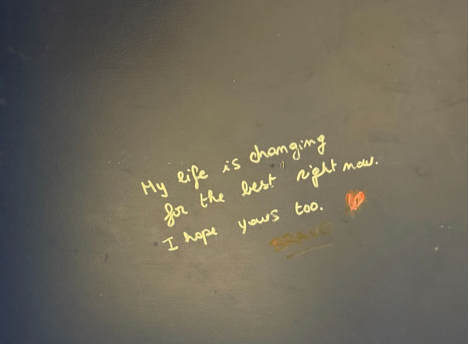
When I got back upstairs, my coffee was ready, and I grabbed it and head outside to keep walking around. It was delicious. It was delicate and floral at first. As it cooled, it hit me in the face with grapefruit, maybe my favorite flavor in coffee. Walking on the cobblestones towards some famous square, I realized that it might be — between the coffee, the setting, and some feeling of fullness in my heart — the best cup of coffee I’d ever had. It might’ve been.
Standing in line, looking at the coffee paraphernalia, I thought about getting a box of beans. This certainly seemed to be a special place — so special that I wanted to enjoy it past this one day, to brew it at home, to make it a part of my life for a while. I wondered, what if I loved it? What if it was better here than anything I had back home? It’d be expensive, going international — but maybe I could make it work. I’d move my budget around. My coffee consumption would look wildly different than it does now. But maybe that’s the way it’s meant to be, the change I’m supposed to make as my life leads me towards myself.
Sitting in that chair, looking out over the city, I decided I wouldn’t. This would just be this coffee, here, in Brussels. Just this one. There’d be plenty more coffees, many of them special, now that I knew what they meant to me. Some would be brewed with care and precision, highlighting all the subtleties of a complex roast, brewed to savor. Others would take me far away to other corners of the world, would fill me up the way this one did. Most would be hastily brewed while rushing out the door to practice, rushed in the pre-sun dark of a sterile hotel room before a morning wave tee time, slipped into my backpack as the final preparation for a long travel day in coach.
Buying a bag, chasing this feeling, that’s no freedom — just a different kind of captivity. It just trades one commitment for another. After all, going out into the world and finding something new — that’s what filled me up. There are so many more special coffees to find in this big beautiful world, whenever I’m ready to go look for one.
But I wasn’t meant to be free anyways. I can’t let go. Not until I’m through with it, or it’s through with me. Not while some part of me, however crazy, misguided, or mad, believes that the next battle will be my Waterloo.
[1] Really, it’s all way more complicated than all of this — seems that 10th century event was more of a land acquisition than a real independence movement. But I promise it truly does not matter for the purposes of this newsletter.
[2] I should be very clear about the fact that I’m getting all of this history directly from Wikipedia — I’m no savant scholar of European history. Apologies to Ms. Sands, my high school Euro teacher. Also, if anyone’s gotten me to misinform my readership by falsifying history on the Wikipedia pages for Louis Bonaparte and the Belgian Revolution, then I tip my hat to you — you got me, fair and square.
[3] I’m relying heavily on Wikipedia here — full citations given to the people editing the pages for the Napoleonic Wars.
[4] Europeans don’t eat breakfast. This means that, if you’re looking for a place to get a to-go breakfast, you won’t find one. Unable to execute my usual Starbucks-en-route-to-the-course gameplan, I had to improvise.
[5] As in, like, standing in the middle of the yard and looking at the house — looking in windows, not Looking In Windows.
[6] On his way out the door, he literally told me he was leaving me the keys and not to lock myself out. He literally said those words to me.
[7] At some point I stopped using Wikipedia and had Claude give me some detailed overviews of specifics of the battle. To be honest, I’m not sure what the rules of engagement are here as far as giving proper academic credit. In any event, it’s been pounded into me over a decade or so that, when in doubt, cite shit, so here I am.
Also, most of the specifics Claude gave me (quotes and such) were either fabricated or wrong — so, please, don’t cite me for anything Waterloo related. I did my best to weed things out, but hopefully my “this guy doesn’t know Napoleonic ball” isn’t showing.
[8] I just made up both of these words, but it’s as close as I’ll get.
[9] Pours-over? [EXTREMELY LOUD INCORRECT BUZZER]
Been saving this piece to read at my favorite coffee shop. A few months later, it was worth the wait. As will your Waterloo be.